中国在1991年把经济增长目标定为“温和的”4.5%,但实际增速超过目标的两倍;到2026年,政府再次提出同样温和的4.5%至5%目标,低于2025年“约5%”的目标。这个对比凸显出增长环境已大不相同:按人均计算的GDP在去年接近13,900美元,是1990年的15倍,而2025年的就业人数却下降了近1.3%。
短期需求也在走弱。2025年表现远超预期的出口,在2026年预计对增长的贡献会更小;以旧换新补贴资金削减六分之一至2500亿元人民币(360亿美元),尽管该计划去年补贴了3.66亿笔购买、带动了2.61万亿元人民币的支出。
投资同样承压,因为政府正在打击过剩产能、价格战和“内卷”,而财政支持仍然有限。名义预算赤字维持在GDP的4%,地方政府“专项”债券额度未提高,农村养老金每月仅增加20元至163元,消费贷款补贴为1000亿元人民币;在这种背景下,野村证券的陆挺预计2026年增长仅为4.3%,低于官方目标,而政府似乎只预期名义增长约为5%。

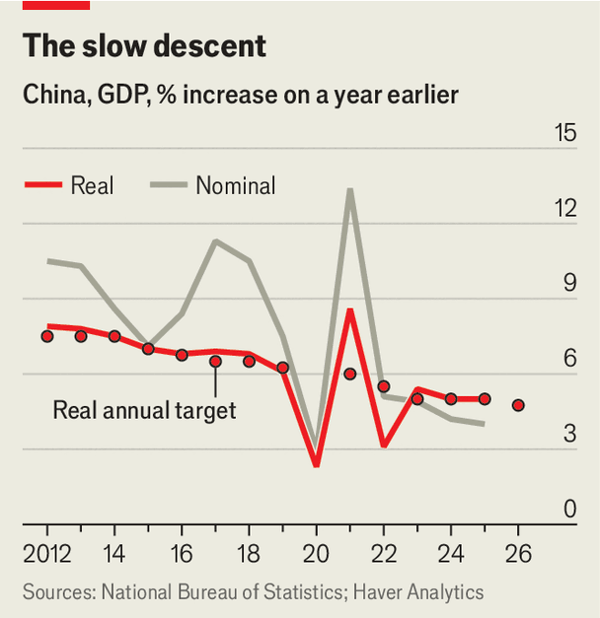
In 1991 China set a “moderate” growth target of 4.5%, yet the economy grew more than twice as fast; in 2026 the government has returned to the same modest 4.5-5% goal, below 2025’s target of “around 5%”. The contrast shows how much the growth backdrop has changed: GDP per person reached nearly $13,900 last year, 15 times its 1990 level, while employment fell by almost 1.3% in 2025.
Short-term demand is also weakening. Exports, which beat expectations by a wide margin in 2025, are expected to contribute less to growth in 2026; cash-for-clunkers subsidies have been cut by one-sixth to 250bn yuan ($36bn), even though the scheme subsidised 366m purchases worth 2.61trn yuan last year.
Investment is under pressure too, because the government is fighting overcapacity, price wars and “involution”, while fiscal support remains limited. The headline budget deficit stays at 4% of GDP, local-government “special” bond quotas are unchanged, rural pensions rise by only 20 yuan a month to 163 yuan, and consumer-loan subsidies are 100bn yuan; against that backdrop, Nomura’s Ting Lu expects only 4.3% growth in 2026, below the official target, while the government itself appears to be assuming only about 5% nominal growth.
Source: China sets its lowest growth target for a generatio
Subtitle: In macroeconomics, modesty is not always a virtue
Dateline: 3月 05, 2026 04:39 上午 | Hong Kong