埃尔布里奇·柯尔比在其2021年的著作中主张,美国军队过度分散,应优先保障亚洲事务并减少其他地区的昂贵投入。然而在唐纳德·特朗普政府领导下,尽管柯尔比担任五角大楼政策主管,美军在全球的分布依然极其分散。尽管美军自2022年俄罗斯入侵乌克兰后派往欧洲的5个旅级战斗队(每队约4000人)中撤出了2个,且将预留给北约的战时部队(包括战机、驱逐舰和潜艇)削减了三分之一(33%),但国会限制将驻欧部队降至76000人以下。此外,拟向波兰增派的5000名士兵预计仅来自欧洲内部调拨,未能真正实现向亚洲的战略转移。
中东地区的局势升级不仅阻止了美军撤离,反而进一步消耗了大量军事资源。自7月7日以来,美军在中东的兵力从40000人增加至约50000人,已有4名美军士兵阵亡,超过100人受伤。尽管6月的谅解备忘录承诺在30天内撤离伊朗周边地区,但海湾基地的导弹袭击迫使美军依赖以色列和约旦的发射场。同时,美军考虑对古巴采取军事行动,加上在波多黎各以及特立尼达和多巴哥的基础设施投资,可能将紧缺的海军资产重新拉回西半球。
因此,美军在太平洋地区的军事部署基本保持停滞,未能获得实质性加强。在这一年中,美军在亚洲仅部署了1艘航母,远低于2艘的理想部署量,创下5年来最长的航母空缺期。美军目前在日本维持约55000名驻军,在韩国维持约27500名驻军,五角大楼甚至考虑抽调驻韩的4500人斯特赖克旅。尽管特朗普向国会申请将2026-27财年的国防预算大幅增长44%至1.5万亿美元,但兵力和装备无法迅速转化,美军被迫在多线牵制中艰难维持对华威慑。
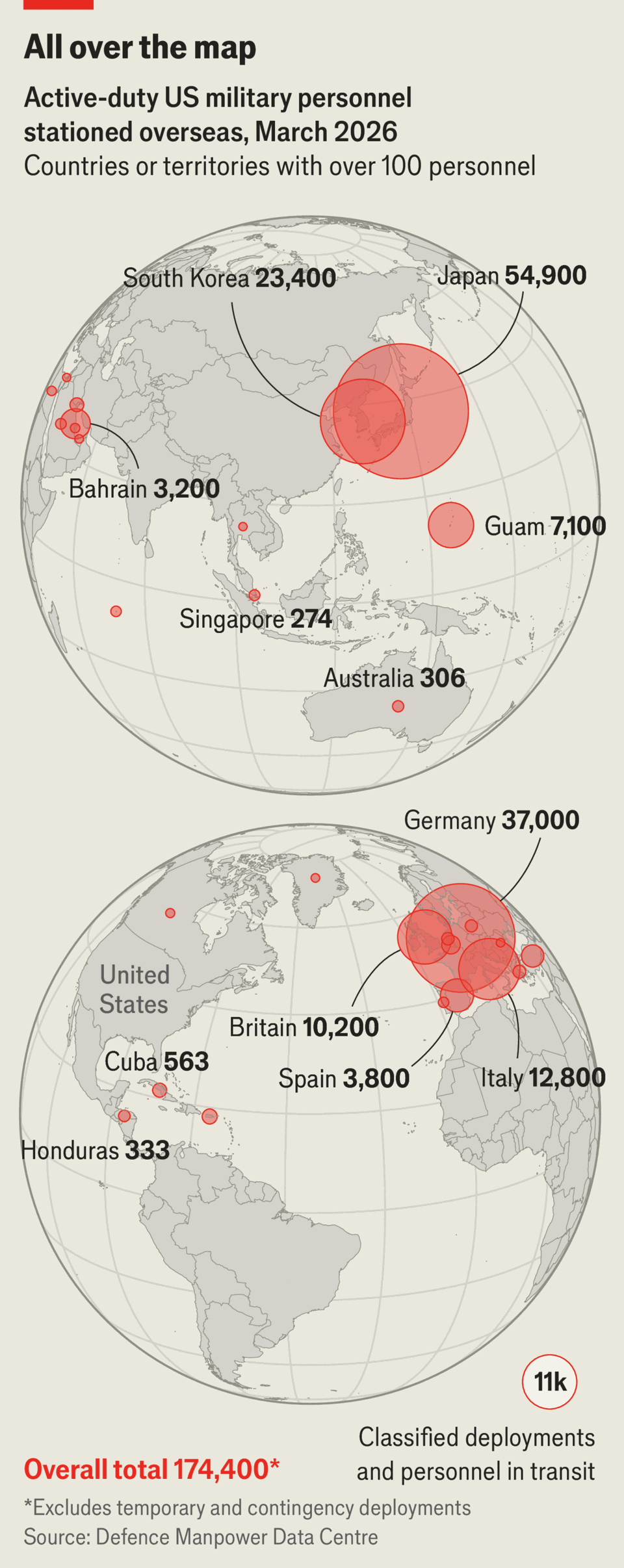
Elbridge Colby argued in his 2021 book that America's armed forces were overstretched and should prioritize Asia while reducing costly commitments elsewhere. However, under Donald Trump's administration with Mr. Colby as Pentagon policy chief, the US military presence remains stubbornly diffuse. Although the US withdrew 2 of the 5 brigade combat teams (around 4,000 troops each) sent to Europe after Russia's 2022 invasion of Ukraine and reduced NATO wartime forces by one-third (33%), Congress blocked troop reductions below 76,000. Additionally, a planned deployment of 5,000 troops to Poland represents reallocation within Europe rather than a strategic pivot to Asia.
In the Middle East, escalating conflict with Iran has absorbed additional military resources rather than enabling force reductions. US troop levels in the region increased from 40,000 to approximately 50,000, with 4 American soldiers killed and over 100 injured since July 7th. Despite a June memorandum promising force removal within 30 days, missile strikes on Gulf bases forced operational reliance on launchpads in Israel and Jordan. Furthermore, potential military options against Cuba and infrastructure investments in Puerto Rico and Trinidad and Tobago threaten to pull naval assets back to the Western Hemisphere.
Consequently, America's military posture in Asia remains static rather than reinforced. For much of the year, the US deployed only 1 aircraft carrier in Asia instead of the preferred 2, marking the longest such gap in 5 years. Standard deployments remain at roughly 55,000 troops in Japan and about 27,500 in South Korea, with officials considering relocating a 4,500-strong Stryker brigade from Korea. Although Mr. Trump requested a 44% increase in the 2026-27 defense budget to $1.5 trillion, budget growth cannot quickly translate into forces, leaving Asian posture constrained by active conflicts elsewhere.
Source: But there are still few signs of a serious pivot to Asia
Subtitle: [[IMAGE]]
Dateline: Jul 23rd 2026