人工智能投资热潮正通过半导体供应链对东亚经济体产生深远的溢出效应,但台湾与韩国在红利分配模式上呈现出截然不同的路径。蓬勃的芯片出口推动韩国年化GDP增速升至约4%,台湾GDP增速更高达惊人的12%,其中二季度私人消费分别贡献了韩国三分之一和台湾五分之一的经济增量。在台湾,作为全球几乎所有先进AI芯片制造者的台积电,其标准硅晶圆年产量从2019年的1000万片扩大至去年的1500万片,同期资本支出从150亿美元激增至410亿美元,带动台湾实际固定资本形成总额自2023年末以来扩张近40%。
伴随生产规模的扩张,台湾的产业红利已广泛传导至普通劳工和公共财政。台湾从事电子元件及计算机制造的劳动力占比升至近11%,创2016年以来新高;巴拉萨-萨缪尔森效应推动全社会名义平均工资年增幅达3.0%,显著高于疫情前1.9%的趋势水平。借助财政税收激增,台湾计划在2027年将社会福利支出扩大40%,赖清德当局更提议耗资70亿美元(约占预期财政收入的6%)向全体公民发放约300美元的“AI红利”,并推行新型育儿津贴,使资本开支迅速转化为居民的可支配财富。
相比之下,韩国的AI收益分配则高度集中于少数头部企业与投资者。由于存储芯片价格在经历低迷后主要呈现价格反弹而非产能暴增,过去一年韩国整体出口价格暴涨57%,但实际固定资本形成近三年仅微增3%,三星电子削减了资本支出,SK海力士三倍扩张的年开支亦仅从60亿美元起步。这导致直接收益仅局限于不足1%的半导体从业人员,全社会名义工资增速回落至疫情前3.5%的基准线以下。加之韩国股市翻倍仅带来每1美元收益转化为1美分消费的微弱财富效应(远低于美国的约5美分),且政府计划将2027年激增50%的税收收入中的70%转入偿债与未来基金,其增长红利预计将主要通过长期基础设施与教育生产力提升缓慢释放。
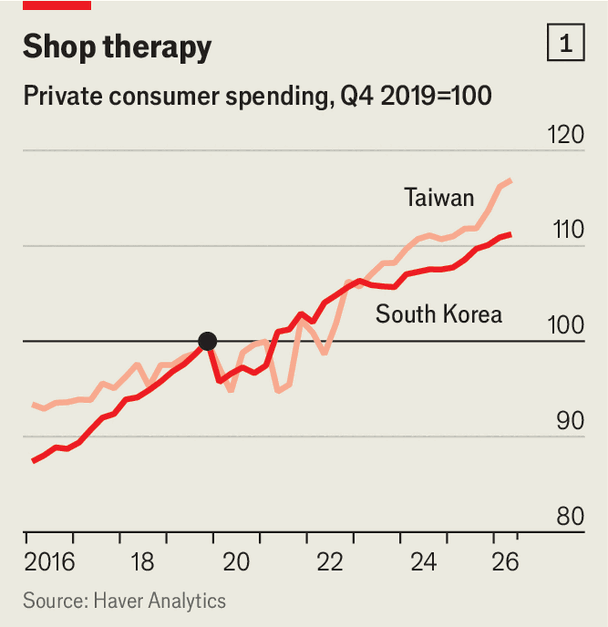
The multi-trillion-dollar artificial-intelligence investment boom is transmitting powerful economic tailwinds across East Asia’s semiconductor powerhouses, though Taiwan and South Korea exhibit sharply divergent distribution models. Booming silicon exports have accelerated annual GDP expansion to 4% in South Korea and a scorching 12% in Taiwan, with reviving private consumption generating roughly one-third of South Korea’s second-quarter GDP growth and one-fifth of Taiwan’s. In Taiwan, market champion TSMC increased standard silicon wafer output from 10m units in 2019 to 15m last year, while annual capital expenditure expanded from bn to bn. This corporate spending binge has driven Taiwanese real fixed capital formation up by nearly 40% since late 2023.
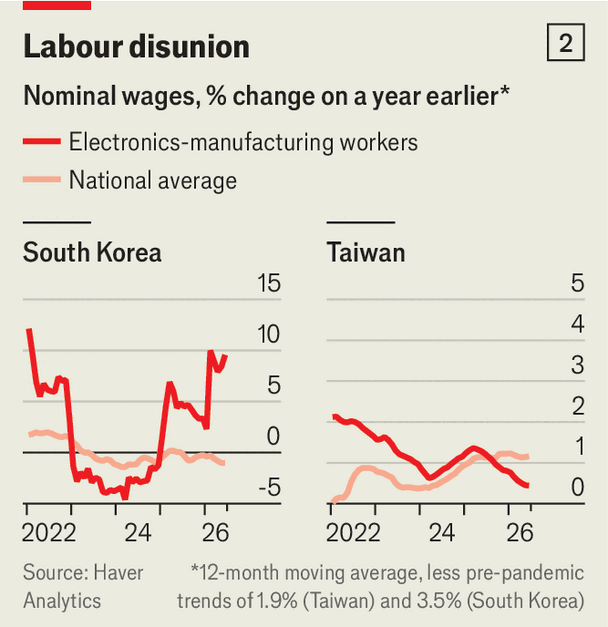
Taiwan’s volume-driven expansion has rapidly filtered down to the broader labour market and public coffers through classical economic spillovers. Electronics and computer manufacturing now employ nearly 11% of the Taiwanese workforce, the highest proportion since 2016, with the Balassa-Samuelson effect pulling nationwide nominal wage growth to 3.0% annually compared to the pre-pandemic trend of 1.9%. Flush with corporate tax receipts, the Taiwanese government plans a 40% boost in social-welfare outlays for 2027. Furthermore, President Lai Ching-te proposed allocating bn—around 6% of projected state revenue—to distribute universal “AI dividends” alongside expanded child benefits, immediately transferring tech windfall gains to household balance sheets.
Conversely, South Korea’s benefits remain heavily concentrated among corporate balance sheets and market elites rather than the general population. Driven by cyclical price spikes rather than volume expansions, South Korean export prices surged 57% over the past year, while real fixed capital formation grew by merely 3% over three years as Samsung trimmed capital spending and SK Hynix expanded from a modest bn baseline. Immediate gains have thus accrued almost exclusively to the less than 1% of the national workforce employed in semiconductor fabrication. Economy-wide nominal wage growth has decelerated below its pre-pandemic 3.5% benchmark, while equity gains generate an expenditure multiplier of merely one cent per dollar (versus five cents in America). Rather than funding cash payouts, the government plans to save 70% of a projected 50% tax revenue increase in 2027 for debt reduction and sovereign reserve funds, targeting durable long-term structural productivity over immediate consumption boosts.
Source: The trickle-down economics of the AI boom
Subtitle: How fast are AI investments translating into broader gains? Taiwan and South Korea offer hints
Dateline: Sep 17th 2026\n