台湾正迅速发展不含中国零部件的无人机产业。产量从2024年的约1万架增长到2025年的超过12倍,出口增长超过35倍至约12.3万架,几乎等于全部产量。主要买家包括捷克和波兰,其中许多最终被转交乌克兰前线使用。2026年前两个月出口已达8.55万架,预计全年仍将保持高增长。部分型号为“自杀式”四旋翼无人机,可携带最高8公斤炸弹并以140公里/小时飞行。尽管价格约为中国同类产品的两倍,但最大卖点是完全不含中国零部件。
台湾政府计划建立完全“非红色”(无中国部件)无人机产业链。目标是在2026年底前实现关键系统去中国化,并在2028年前将年产量提高到18万架,同时计划到2033年前为本国军队采购超过20万架无人机。全球无人机生产中约70%至80%来自中国,因此供应链安全成为核心议题。为减少依赖,中国来源的关键模块必须在2026年初前被替代,而被动部件如光学镜头和稀土磁体需在2027年1月1日前淘汰。政府还承诺投入14亿美元弥补芯片和关键技术缺口,并计划到2029年实现稀土磁体需求的一半本地化。
产业扩张也伴随成本与政治挑战。部分台湾厂商过去约40%的零部件来自中国,如电池、电机和螺旋桨,如今转向本地或日本等伙伴供应。虽然成本上升,但仍约为日本或韩国完全本土生产无人机价格的一半。美国正要求台湾将国防支出从GDP的3%提高到10%,同时推动其加入西方无人机供应链。长期不确定性包括国内政治分歧以及全球需求变化,例如乌克兰每年可生产约500万架无人机,若战争结束可能对市场形成竞争压力。
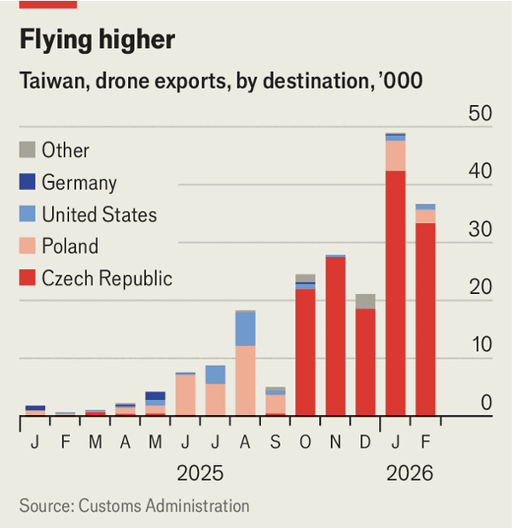
Taiwan is rapidly developing a drone industry free of Chinese components. Production rose from about 10,000 units in 2024 to more than twelve times that level in 2025, while exports increased more than thirty-fivefold to roughly 123,000 units, nearly matching total output. Major buyers included the Czech Republic and Poland, with many drones ultimately deployed on Ukraine’s battlefield. In the first two months of 2026 exports already reached 85,500 units, suggesting another strong year. Some models are kamikaze quadcopters capable of carrying bombs of up to 8kg and flying at 140kph. Although they cost about twice as much as comparable Chinese drones, their main advantage is the absence of Chinese components.
The government aims to build a fully “non-red” drone supply chain. Key systems must be free of Chinese parts by the start of 2026, with remaining passive components such as lenses and rare-earth magnets phased out by January 1st 2027. Taiwan plans to raise annual drone production to 180,000 units by 2028 and has pledged to purchase more than 200,000 drones for its own armed forces by 2033. Because China accounts for roughly 70–80% of global UAV production, supply-chain security has become a major concern. To address technological gaps, the government has committed $1.4bn to support domestic capabilities and aims to produce half of its required rare-earth magnets locally by 2029.
Industry expansion also involves cost and political challenges. Some Taiwanese firms previously sourced about 40% of components from China, including batteries, motors and propellers, but are shifting to domestic or allied suppliers such as Japan. Costs have risen, yet the drones remain about half the price of models fully produced in Japan or South Korea. The United States is urging Taiwan to increase defence spending from 3% of GDP to 10% and integrate more deeply into Western drone supply chains. Long-term uncertainty includes domestic political divisions and potential shifts in global demand, as Ukraine alone may produce about 5m drones annually and could eventually flood the market.