面对国内汽车市场预计收缩10%所引发的惨烈价格战,生产全球约四分之一汽车的中国车企正大举出海建厂。2026年中国汽车出口量预计将突破1,000万辆,同比增长逾40%。尽管欧盟在2024年加征反补贴关税,但中国车企在西欧的市场份额仍在今年第二季度攀升至11%,一举超越日系竞争对手。为了规避昂贵海运运费、关税壁垒以及欧盟即将出台的《工业加速器法案》(该法拟将购车补贴与本地化生产比例深度捆绑),中国整车厂正从整车纯出口全面转向在海外就地设厂。
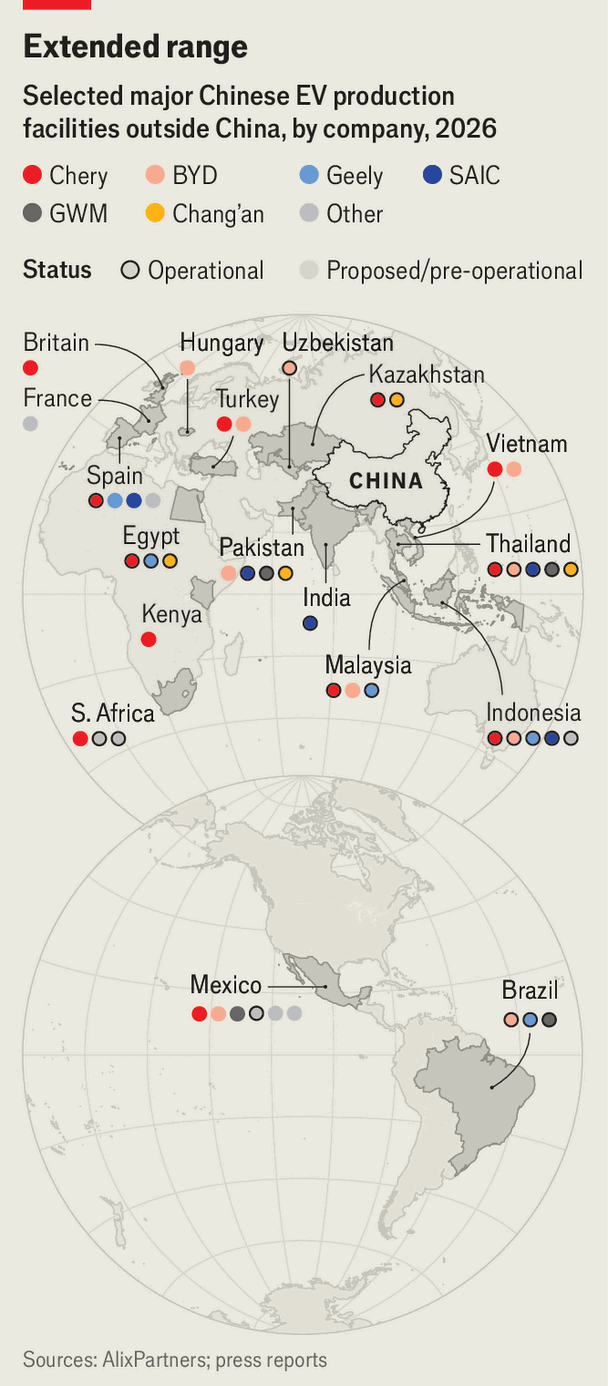
为争夺欧洲核心市场并压缩通常耗时三年的绿地建厂周期,中国车企正采取多元化的产能扩张路径。比亚迪在匈牙利的30万辆年产能工厂投产在即,同时放缓土耳其项目,转向在法西两国物色现成工厂;奇瑞与日产签署协议共享英国桑德兰工厂,吉利则利用福特在西班牙瓦伦西亚的闲置产线代工电动汽车,高效盘活欧洲汽车业高达250万辆的闲置产能。此外,大众汽车近期获批关停四座德国本土工厂,为中资低成本收购成熟产线提供了契机。上汽集团与小鹏汽车亦在加速敲定西班牙及泛欧永久生产基地的布局。
欧洲传统车企原本指望海外生产的高企成本能削蚀中国对手约30%的成本优势,但这一设想恐难实现。中国车企的核心壁垒源于高度扁平的管理架构、极致的垂直整合以及领先的“软件定义汽车”集中电子电气架构——整车零部件数量仅1,000至2,000个,远低于欧洲同行的3,000至10,000个,且车型研发周期仅需约两年(较外资车企缩短一半以上)。尽管面临欧洲本地供应链要求与售后渠道开支,但中企通过在匈牙利、斯洛伐克等东欧低成本区布局,并计划直接输出全自动化的“黑灯工厂”,有力抵御了劳动力成本膨胀。咨询机构预计,中国车企在欧年产量将从今年的9万辆激增至2030年的100万辆,其全球扩张势头势不可挡。
Facing an anticipated 10% domestic market contraction that has exacerbated intense price wars, Chinese carmakers—responsible for a quarter of global automobile output—are aggressively expanding overseas production facilities. Projected 2026 exports will exceed 10m vehicles, up over 40% year-on-year. Despite punitive tariffs imposed by Brussels in 2024, Chinese brands captured 11% of western European auto sales in the second quarter of 2026, overtaking Japanese rivals. To circumvent steep tariffs, logistics costs, and the European Union’s proposed Industrial Accelerator Act—which ties fleet subsidies and tax relief to strict regional production thresholds—Chinese manufacturers are rapidly accelerating local factory investments.
To bypass the three-year construction timeline typical of greenfield projects, Chinese firms are creatively absorbing Europe's estimated 2.5m units of excess manufacturing capacity. BYD is preparing to open its 300,000-capacity plant in Hungary while scouting brownfield sites across France and Spain, having paused its planned Turkish facility. Joint-use agreements are surging: Chery secured capacity at Nissan’s Sunderland plant in Britain, while Geely arranged EV assembly at Ford’s facility in Valencia. Moreover, Volkswagen’s recent decision to phase out manufacturing across four German sites creates opportunities for Chinese buyers to acquire established factory footprints. Simultaneously, SAIC and Xpeng are pursuing dedicated production hubs in Spain and continental Europe.
European incumbents hoping that overseas expansion will erode China’s estimated 30% cost advantage will be disappointed. China's competitive edge stems from structural vertical integration, lean management, and advanced centralised "software-defined vehicle" architectures requiring just 1,000–2,000 parts, compared with 3,000–10,000 among Western incumbents. Crucially, "China speed" enables new vehicle development in roughly two years—half the Western timeline. While Chinese transplants must navigate local dealer buildouts and supplier integration, they heavily target low-wage eastern European hubs like Hungary and Slovakia. Coupled with the export of highly automated, unmanned "dark factories," Chinese auto production in Europe is projected to soar from 90,000 units this year to 1m by 2030.
Source: Chinese carmakers are bringing their factories to the world
Subtitle: Incumbents will have to accelerate to compete
Dateline: Sep 10th 2026