过去十年间,占瑞士钟表总销量95%的出口总量暴跌了一半,尤其是传统石英表在亚洲智能手表的冲击下遭受重创。然而,瑞士钟表业的出口总额却持续逆势攀升,2025年8月的出口额同比增长9.1%,实现连续四个月正增长。瑞士全境虽有约450个钟表品牌,但劳力士(Rolex)、卡地亚(Cartier)、百达翡丽(Patek Philippe)、欧米茄(Omega)和爱彼(Audemars Piguet)这五大顶级品牌去年就掠夺了全行业60%的营业收入。超高端市场增长尤为强劲:售价超过5万瑞士法郎的钟表占瑞士钟表出口总额的比重,从2024年的33.5%跃升至2025年的37%,展现出极富阶层对奢华稀缺资产的强劲需求。
作为行业绝对霸主,劳力士去年销售了近120万枚腕表,平均售价达1.4万瑞士法郎(约合16,800美元),凭借强劲的提价能力将营业收入从2020年代初的约80亿瑞士法郎推高至超过110亿瑞士法郎,其营收规模是排名第二的卡地亚的三倍。劳力士由汉斯·威尔斯多夫基金会全资控股,收益主要回流于研发与日内瓦的慈善事业。高端化浪潮也催生了新兴家族独立制表品牌的崛起,例如2018年成立的Norqain平均售价达4,500瑞士法郎,年销量已达1万枚,通过引入瑞典铁陨石和高性能碳纤维复合材料打造限量奢华表款实现差异化突围。
相比之下,曾在20世纪80年代以塑料石英表拯救瑞士钟表业的最大上市表企斯沃琪集团(Swatch Group)则深陷泥潭。由于错失高端化红利且背负臃肿的制造资产,斯沃琪年产量已从过去的1,500万枚骤降至仅400万枚,却未关闭其在瑞士的150家工厂中的任何一家,导致其去年净利润暴跌近90%,股价较2023年初下跌逾40%,较2013年历史峰值下跌近70%。尽管斯沃琪随后通过与爱彼联名推出塑料版“皇家橡树”口袋表(Royal Pop)引发全球排队抢购并在2025年上半年提振了销售额,但净利润同比依然萎缩。瑞士钟表业的分化格局表明,单纯依靠大众制造已难以为继,极致奢华与稀缺手工艺已成为行业生存的核心支柱。
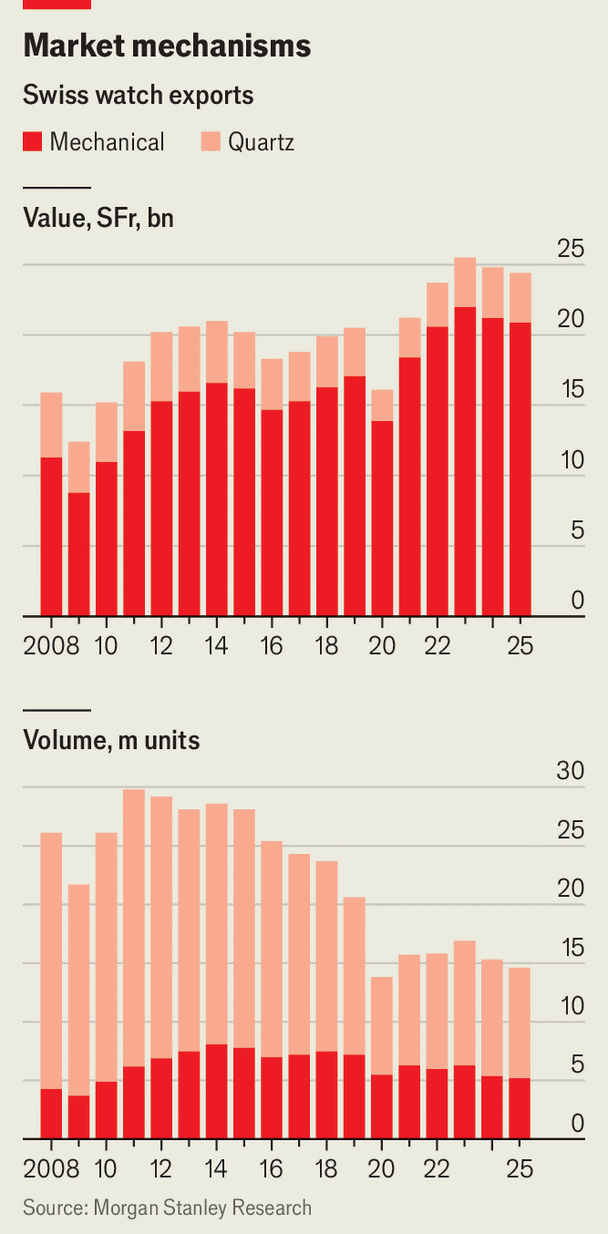
Over the past decade, the volume of Swiss watch exports—which constitute 95% of total industry sales—has halved under severe competitive pressure from Asian smartwatches displacing entry-level quartz movements. However, aggregate export values have climbed steadily, rising 9.1% year-on-year in August 2025 to mark four consecutive months of revenue expansion. While Switzerland hosts approximately 450 watchmaking brands, market concentration has intensified radically: just five elite houses—Rolex, Cartier, Patek Philippe, Omega, and Audemars Piguet—captured 60% of total industry revenue last year. Ultra-luxury models have driven this boom, with timepieces priced above SFr50,000 ($59,500) expanding their share of total export value from 33.5% in 2024 to 37% in 2025.
Rolex dominates the sector, generating more than SFr11bn in annual revenue—up from roughly SFr8bn in the early 2020s on flat production volume—by selling nearly 1.2m watches at an average retail price of SFr14,000 ($16,800). Its sales are triple those of second-ranked Cartier. Controlled by the non-profit Hans Wilsdorf Foundation, Rolex channels retained earnings into precision engineering and philanthropy. Independent family-owned marques have similarly capitalized on this premiumisation trend; for instance, Norqain, established in 2018, now sells up to 10,000 watches annually at an average price of SFr4,500 by incorporating exotic materials like Swedish iron meteorites and bespoke carbon composites into limited production runs.
Conversely, Swatch Group, Switzerland's largest publicly listed watchmaker and savior of the industry during the 1980s quartz crisis, faces severe structural distress after failing to capitalize on premiumisation. Burdened by 150 Swiss factories that previously manufactured 15m timepieces annually but now produce merely 4m with zero facility closures, Swatch's net profit collapsed by nearly 90% last year, and its market valuation has fallen over 40% since early 2023 (and nearly 70% from its late-2013 peak). Despite collaborative mass-market launches, such as the co-branded plastic Royal Pop pocket watch with 151-year-old Audemars Piguet, Swatch's interim net earnings continue to decline, highlighting how structural profitability has shifted definitively from high-volume manufacturing to ultra-luxury exclusivity.
Source: The Swiss watch industry is shrinking—but getting swankier
Subtitle: Brands such as Rolex and Patek Philippe are consolidating the market
Dateline: Oct 1st 2026\n