欧洲工业目前面临严峻挑战,在补贴前,德法两国的工业用电价格约为美中两国的两倍,而中国对欧盟的商品贸易顺差自2019年以来增加了一倍多,达到4,200亿美元。汽车行业遭受的冲击尤为严重,欧盟汽车产量较疫情前水平下降了17%,五家欧洲主要车企今年相继发布盈利预警,直接威胁到占欧盟6%的就业岗位。咨询公司麦肯锡的研究显示,在制药、电子和化工等六个关键行业中,欧洲在2024年的投资额均落后于中美两国,且在任一行业中均未拔得头筹。
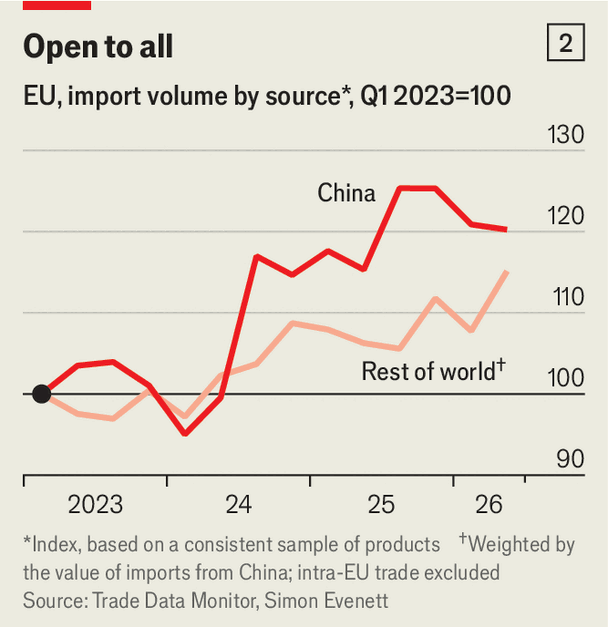
然而,所谓欧洲全面“去工业化”的论调严重夸大了危机,实际阵痛高度集中在特定领域和国家。德意志银行的数据显示,制造业占欧盟总增加值的比重近年来稳定维持在16%左右;自2023年初以来,欧盟制造业就业人数虽微降2%至2,800万人,但其中80%的降幅由德国一国承担,且高技能岗位(工程师与技术人员)逆势增长了7%。制药、航空航天及国防军工正在加速扩张,西门子、施耐德电气及普睿司曼等企业更在人工智能算力中心基建浪潮中获利丰厚。此外,瑞士国际管理发展学院(IMD)研究显示,自2023年以来欧盟自华进口增速仅略高于全球其他地区,在德国百大对华进口商品中仅有11类出现量增超25%且降价超10%的剧烈竞争。
更为关键的是,中国出口增长中有四分之三属于锂电池和机械臂等中间品,欧洲央行研究表明,在2000至2022年间,中间品进口使相关行业年产出增速提高了0.6个百分点。欧洲企业正展现出强大的适应能力:在太阳能丰富的西班牙,企业年投资额在2021至2025年间较前五年翻了一番;索尔维与K+S等化工巨头已基本锁定年内能源对冲,2024年欧盟工业服务出口额更达到4,600亿美元(两年内增长21%)。德国的员工机器人密度目前高居全球第三,仅次于新加坡与韩国。欧洲工业的未来不在于挽留夕阳产能,而在于能否加速追赶在人工智能领域与美中拉开的代差。
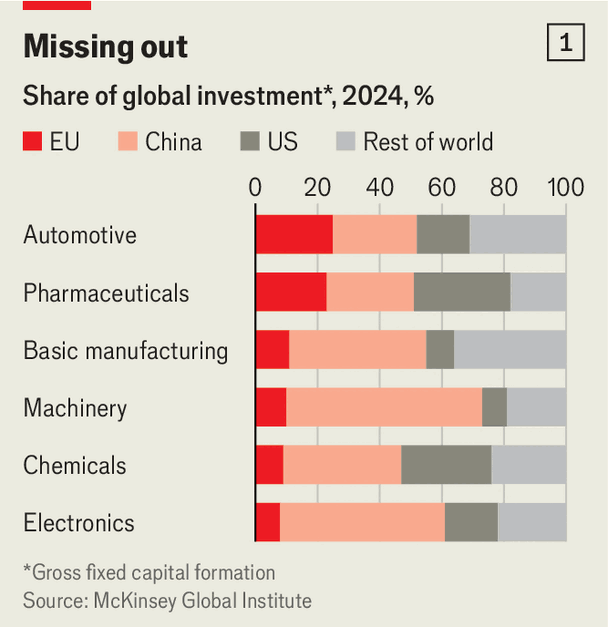
European industry confronts substantial headwinds from elevated structural energy costs—with pre-subsidy industrial electricity prices in France and Germany running roughly double those of America and China—and a soaring goods trade deficit with China that has more than doubled since 2019 to $420bn. The automotive sector has absorbed the heaviest blow, with EU vehicle production down 17% from pre-pandemic benchmarks and five European carmakers issuing profit warnings this year, jeopardizing a sector providing 6% of EU employment. A McKinsey study of six core industries shows that Europe secured less capital investment in 2024 than America and China across pharmaceuticals, electronics, and chemicals, leading in none.
Nevertheless, fears of comprehensive deindustrialisation are overblown, as structural pain remains highly sector- and country-specific. Deutsche Bank data indicates that manufacturing has held steady at roughly 16% of total EU gross value added. Although total manufacturing employment slipped 2% since early 2023 to 28m, Germany accounted for fully four-fifths of that contraction, while high-skilled engineering and technical roles expanded by 7%. Meanwhile, aerospace, pharmaceuticals, and defence contractors are expanding rapidly, and equipment suppliers like Siemens, Schneider Electric, and Prysmian are capitalizing on global AI infrastructure buildouts. Furthermore, IMD trade analysis reveals that European imports from China have grown only marginally faster than imports from other global partners since 2023, with acute import surges and price deflation confined to just 11 of Germany's top 100 imported product categories.
Significantly, components and capital goods—such as EV batteries and robotic automation—account for three-quarters of recent Chinese export growth, providing cost efficiencies that the European Central Bank found raised annual industrial output growth by 0.6 percentage points in exposed sectors between 2000 and 2022. European corporations are adapting dynamically: industrial investment in solar-rich Spain doubled between 2021 and 2025 compared to the previous five years, widespread energy hedging has mitigated winter volatility, and manufacturing service exports rose 21% over two years to $460bn in 2024. With Germany maintaining the world’s third-highest industrial robot density per employee behind Singapore and South Korea, Europe's fundamental industrial imperative is not defending legacy manufacturing, but rapidly narrowing its technology deficit in applied AI.
Source: European industry is doing better than you may think
Subtitle: The firms most exposed to China are suffering. But many are adapting
Dateline: Oct 1st 2026\n