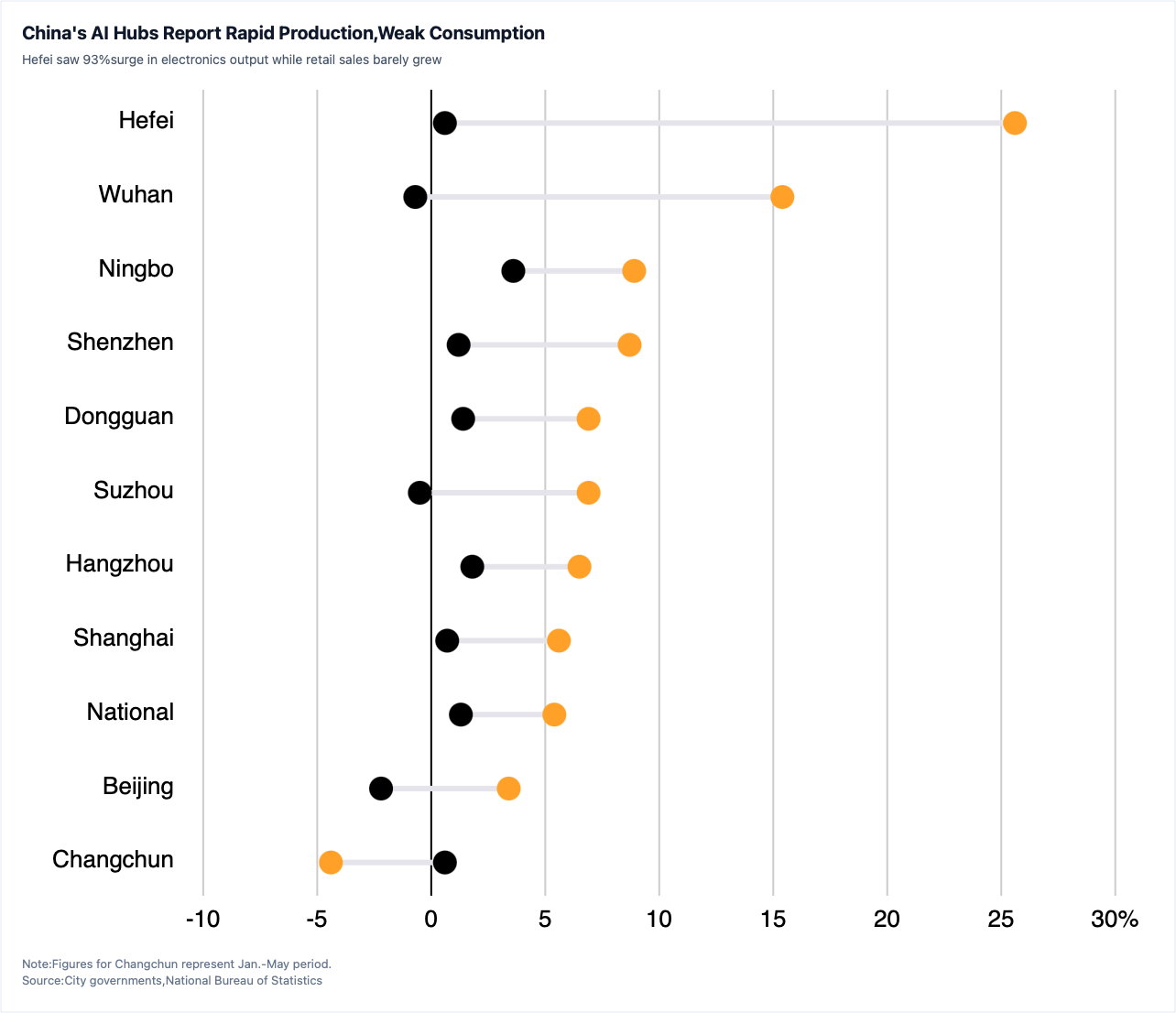
即便在这些AI繁荣城市内部,经济红利也难以惠及普通家庭。合肥电子产品产出飙升93%,但零售销售几乎未见增长;自动化和临时工的大量使用使得消费经济并未因制造业的繁荣而改善。AI产业在中国仅雇用约一千万人,占整体工业劳动力的9%,牛津经济研究院经济学家指出,AI热潮的收益「不成比例地流向了资本而非劳动者」。
这种区域分化预计将进一步加深。长鑫存储(CXMT)完成中国历史上第二大IPO,为持股约40%的安徽省带来1920亿美元的财富效应,而湖南、山西等中西部省份则因传统产业放缓和矿难等因素增长乏力。野村证券经济学家认为,北京可能需要在下半年加大政策力度,但中共中央政治局会议的表态仍偏审慎,未宣布新的刺激措施。
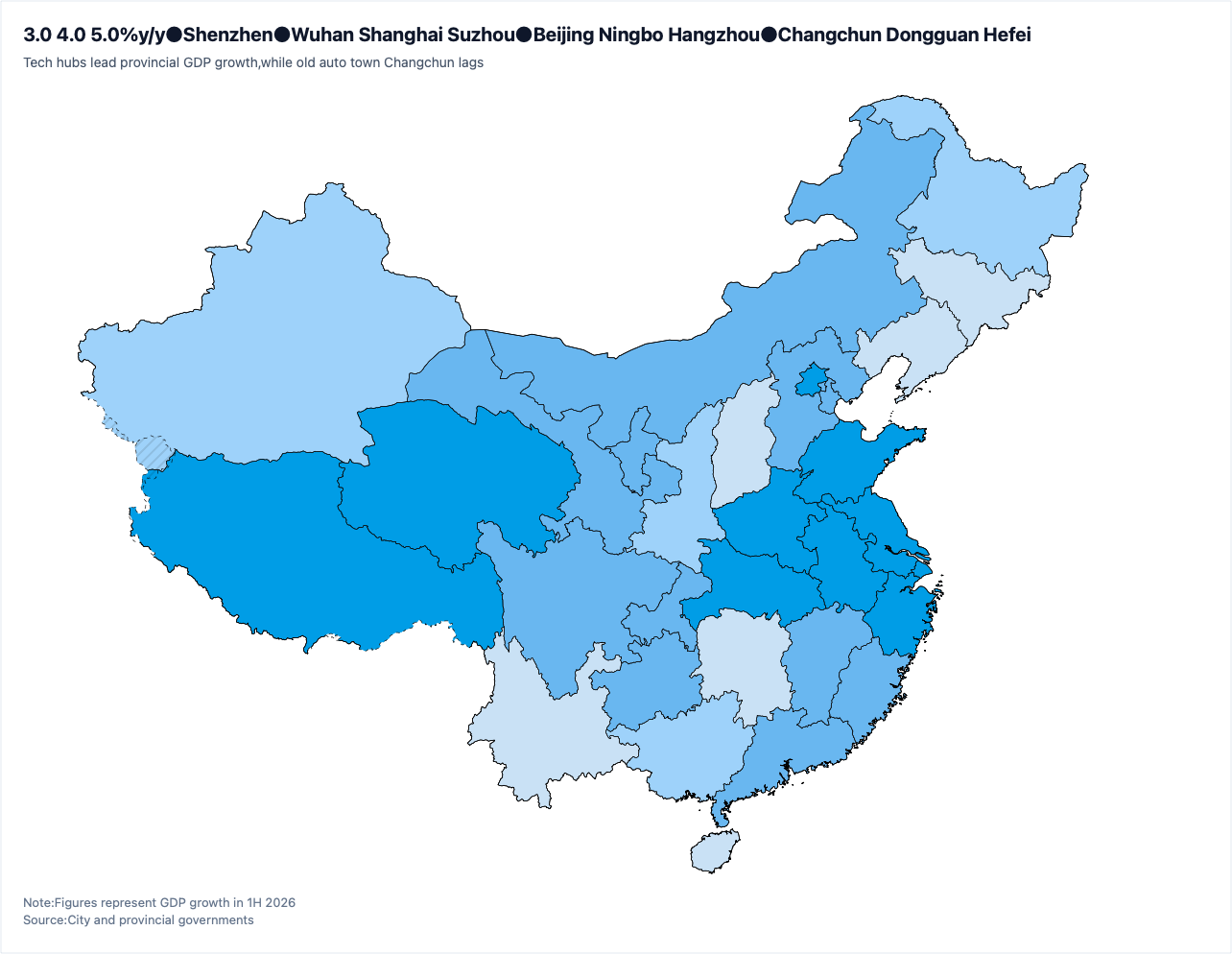
China's AI boom is creating a stark economic divide between a handful of high-tech hubs and the rest of the country. Cities like Hefei, Shenzhen, Wuhan, and Suzhou recorded GDP growth well above the national average in the first half of 2026, driven by surging demand for memory chips, optical modules, and other AI-related hardware. In contrast, cities dependent on legacy industries—most notably Changchun, where the auto sector accounts for roughly 60% of industrial output—saw growth plummet amid a global oil shock and falling domestic car sales.
Despite the impressive headline growth in AI boomtowns, the benefits have largely failed to reach ordinary households. Retail sales in several of these cities are shrinking, as factory automation and heavy reliance on temporary labor limit the trickle-down effect. The AI sector employs only about 10 million workers in China, and economists at Oxford Economics note that gains from the boom have accrued disproportionately to capital owners rather than workers—a pattern echoed across Asia. (Key numbers: 93, 9)
The regional divide is expected to widen further as eastern and well-connected central provinces leverage industrial clusters, resilient exports, and superior access to talent and capital. CXMT's blockbuster IPO delivered a $192 billion windfall to Anhui province, while western and northeastern regions face fiscal constraints and sluggish industrial upgrading. Nomura economists argue that Beijing will likely need to step up policy support in the second half, though the Politburo's latest signals suggest a measured rather than aggressive stimulus approach. (Key numbers: 40, 1920)