开源权重(Open-Weight)人工智能模型的普及正在对美国顶尖闭源实验室构成严峻挑战。根据研究机构Epoch AI的分析,主要来自中国的人工智能实验室在开源权重模型的技术能力上仅落后行业顶尖水平几个月。中国创业公司月之暗面(Moonshot AI)于7月16日发布了Kimi K3,阿里巴巴也推出了Qwen系列新模型的预览版。在模型交易平台OpenRouter上,2026年6月使用顶级美国模型的 token 消费量上升了35%,而中国开源模型的消费量增长了165%,在5月其使用量更是达到了美国竞争对手的两倍以上。
显著的成本优势与高效的架构创新驱动了开源模型的快速渗透。研究机构Artificial Analysis的数据显示,DeepSeek最顶尖的模型执行测试任务的平均成本仅为0.04美元,而月之暗面的K3平均成本为0.95美元,相比之下使用Anthropic的Fable模型则需支付2.75美元。在第三方云服务提供商中,DeepSeek的v4 flash模型每百万token仅收费0.18美元。受制于美国对高端芯片的出口限制,中国实验室广泛采用了“专家混合”(Mixture of Experts)等高效架构,在不牺牲核心性能的情况下显著降低了算力消耗与运维成本。
地缘政治的不确定性与监管动向进一步改变了企业对AI模型的选择策略。由于美国政府曾施加限制导致Fable模型全球暂停服务三周,许多企业开始警惕对单一闭源实验室的依赖,转而测试并部署开源权重替代方案。虽然美国政界与监管部门担忧中国模型可能带来网络攻击威胁并拟采取黑名单等限制措施,但中国政府亦在考虑限制海外获取其开源技术。这一双向的监管壁垒使得开源与闭源技术力量的对比演变为全球人工智能产业布局的核心变量。
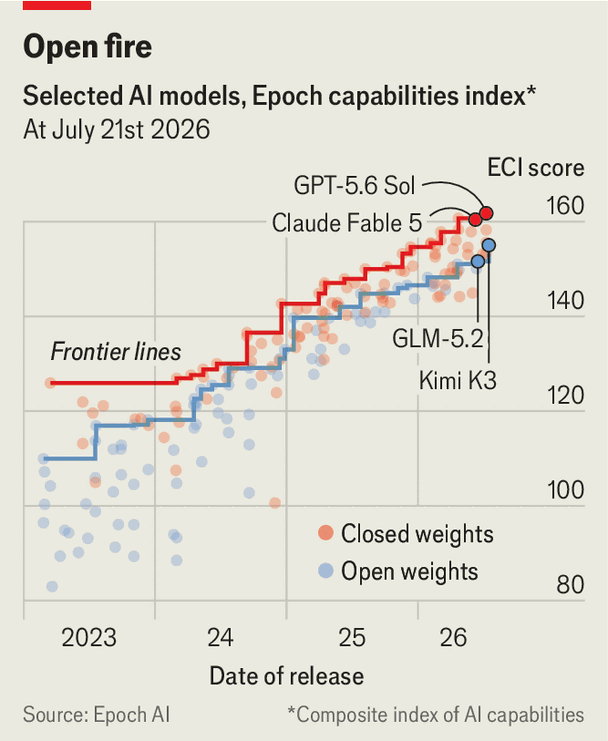
Demand for open-weight artificial intelligence models is accelerating rapidly, narrowing the gap with closed-source frontier developers. According to analysis by research firm Epoch AI, the most capable open-weight models—primarily originating from Chinese laboratories—are only a few months behind cutting-edge proprietary systems. Models such as Moonshot AI's Kimi K3 and Alibaba's expanded Qwen family match near-frontier performance. Data from model marketplace OpenRouter reveals that while token consumption for top American models grew by 35% in June 2026, usage of Chinese open-weight models surged by 165%, after having logged double the consumption of American rivals in May.
Substantial cost differentials and optimized architectures are driving commercial adoption of open-weight alternatives. Research from Artificial Analysis demonstrates that executing standard benchmark tasks via DeepSeek's leading model costs an average of $0.04 per job, compared to $0.95 for Kimi K3 and $2.75 for Anthropic’s flagship Fable model. Third-party cloud providers offer DeepSeek's v4 flash model at rates as low as $0.18 per million tokens. Facing export restrictions on advanced semiconductors, Chinese developers have utilized efficient designs like "mixture of experts" (MoE) architectures, reducing computational demands while maintaining operational performance.
Geopolitical friction and regulatory instability are further encouraging enterprise migration toward open-weight architectures. A temporary three-week disruption of Anthropic's Fable model due to US export compliance checks prompted global firms to reduce single-vendor reliance and adopt open-weight systems run on internal or multi-cloud infrastructure. While American policymakers consider trade restrictions and blacklists against Chinese model developers, regulators in Beijing are similarly evaluating export controls on domestic AI models, underscoring how open-weight access is reshaping global competitive dynamics.
Source: Demand for open-weight models is soaring
Subtitle: [[IMAGE]]
Dateline: Jul 23rd 2026