美伊战争引发霍尔木兹海峡长期封锁与红海航运受阻,迫使中东地区在经历数个世纪的海运主导后,迎来陆运通道的重大复兴。为绕开瘫痪的水道,伊拉克每日派出约1300辆重型卡车横跨沙漠,将南部油田的原油运往叙利亚地中海港口巴尼亚斯,虽仅占战前出口的5%,却标志着区域互联互通逻辑的巨变。阿联酋杰贝阿里港事实性关闭,迪拜国际机场上半年货运和客运量同比暴跌30%,促使土耳其经陆路向海湾供货、巴基斯坦重开对伊边境口岸,跨国卡车运输迎来空前繁荣,并有效化解了海湾地区的物资短缺危机。
铁路与跨境能源基础设施建设亦在战火倒逼下全面提速。伊朗里海港口至德黑兰的货运列车频次达每20分钟一班,伊朗通往阿富汗及土库曼斯坦至中国的铁路货运量大幅激增;海湾阿拉伯国家合作委员会(GCC)加速推进耗资2500亿美元、连接科威特至阿曼的2100公里铁路网,土叙沙等国更计划重启历史性的汉志铁路。能源方面,伊拉克正加紧推进耗资46亿美元、日输送量200万桶的巴士拉-哈迪塞管道,雪佛龙与沙特阿美等巨头亦在评估通往地中海的输油管道重建;针对海水淡化厂遭袭,海湾国家正推动水网互联。
数字基础设施也在规避红海海缆频遭破坏的风险。沙特电信斥资8亿美元签署跨越叙利亚、连接欧亚的4500公里“丝路之链”陆地光缆协议。尽管海运成本远低于陆运(叙交通部长估算海运成本比铁路低6倍、比公路低20倍、比空运低300倍),且战火威胁与财政吃紧可能使部分蓝图落空,但持续的海洋封锁正在从根本上重构中东的经济地理,迫使长期依托远洋贸易和外部大国保护的邻国们建立紧密的陆上经贸共生网络。
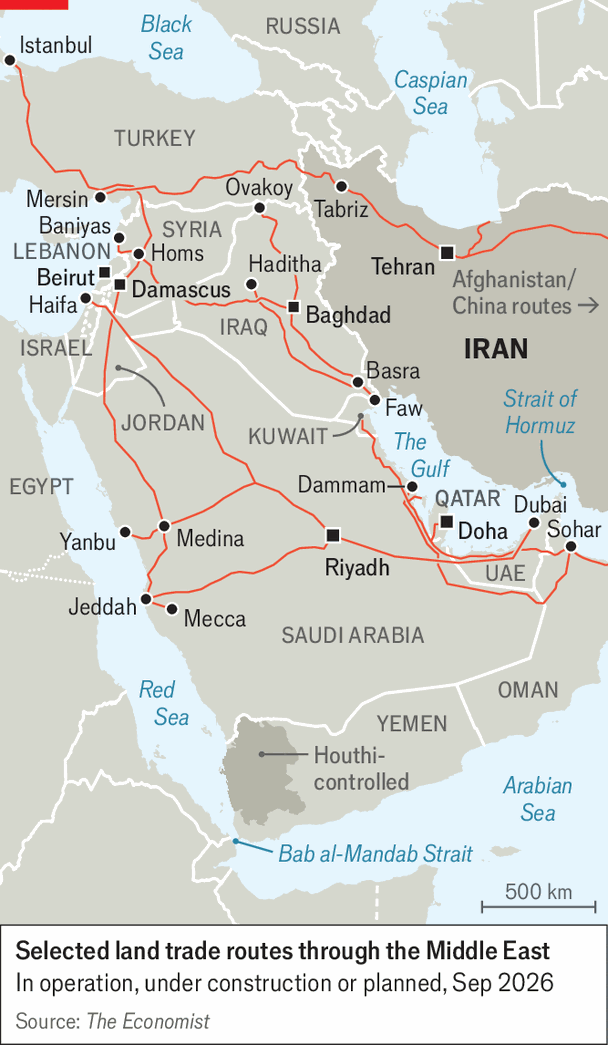
Prolonged maritime disruption from the US-Iran war and recurrent blockades of the Strait of Hormuz are driving a historic revival of overland trade routes across the Middle East. With Dubai's Jebel Ali port largely immobilized and Dubai International Airport's cargo and passenger traffic dropping 30% year-on-year in early 2026, overland logistics have exploded. Iraq currently dispatches roughly 1,300 fuel trucks daily through desert routes to Syria's Mediterranean port of Baniyas. Meanwhile, long-haul trucking corridors stretching over 2,000km from Turkey and 1,600km from Saudi Red Sea ports have averted Gulf food shortages, prompting Pakistan and regional states to open land crossings and streamline customs checks.
Rail and regional pipeline initiatives are experiencing unprecedented acceleration under wartime pressure. Freight traffic between Iranian Caspian ports and Tehran runs every 20 minutes with Russian agricultural imports, while rail transit linking Iran to Afghanistan and onwards to China via Turkmenistan has expanded. Concurrently, Gulf Cooperation Council leaders have accelerated a long-stalled 2,100km, $250bn rail network linking Kuwait to Oman, alongside talks between Turkey, Syria, and Saudi Arabia to revive the historic Hijaz railway. In hydrocarbons, Iraq fast-tracked a $4.6bn, 2m-barrel-per-day pipeline from Basra to the Syrian border, while global energy giants explore Mediterranean evacuation routes, and Gulf states integrate electricity and water networks.
Telecommunications infrastructure is undergoing an identical terrestrial pivot following recurring Houthi sabotage of Red Sea submarine cables. Saudi Telecom signed an $800m agreement with Syria to construct the "Silklink," a 4,500km terrestrial fiber-optic line connecting Europe and Asia. While ocean transport remains overwhelmingly cost-efficient—Syrian officials estimate maritime shipping is six times cheaper than rail and twenty times cheaper than trucking—and regional security risks persist, prolonged maritime insecurity is reshaping Middle Eastern economic geography, forcing historic adversaries and neighbors to forge direct overland economic ties.
Source: As the Iran war menaces shipping, land routes are making a comeback
Subtitle: That could rejuvenate regional trade in the Middle East
Dateline: Sep 10th 2026