随着布伦特原油价格自7月以来再度突破每桶100美元大关,美伊之间围绕霍尔木兹海峡通行状况爆发了激烈的“数据舆论战”。唐纳德·特朗普宣称海峡原油运量已恢复至每日1800万桶(接近战前2000万桶的水平),副总统万斯更宣称伊朗已丧失海峡控制权;然而,伊朗安全高官驳斥其为谎言,称每日仅有七八艘船只通过,大宗商品数据机构Kpler亦显示截至8月30日当周的日均外运量低于500万桶。双方政治动机鲜明:白宫急于证明每日耗费数百万美元护航卓有成效,而伊朗则力求展示封锁威慑力。
统计数据的巨大鸿沟源于严峻的战场现实与技术盲区。为免遭打击,大多数油轮关闭了应答器、在卫星无法窥视的夜间航行,甚至遭遇大范围无线电干扰或主动伪造位置;此外,大量中东原油先通过小型穿梭船运出海峡,再在公海秘密过驳。商业追踪机构只能通过装卸港数据进行事后追溯和滞后上调(如Kpler将8月10日当周数据由470万桶上修至720万桶)。即便官方可能采用将成品油及沙特红海管道(日增100万至300万桶)、阿联酋富查伊拉管道(日增100万桶)等绕行海峡路线合并计算的宽泛口径,特朗普声称的1800万桶依然严重脱离实际。
霍尔木兹海峡的航运脆弱性远未消除,且安全形势极易逆转。近期双方交火与伊朗威胁已导致海峡通行量骤降,Kpler记录的单日过境船只从单周前的23艘暴跌至9月8日的8艘;同时胡塞武装的袭船行动也制约了红海绕行路线。当前过境霍尔木兹的船舶战争险费率仍高达船价的10%(战前仅为0.25%),水雷威胁与导弹打击风险持续笼罩。随着近月原油基准价格突破每桶113美元、美国柴油突破200美元,特朗普关于战争将持续至中期选举之后的表态进一步加剧了能源市场的剧烈震荡。
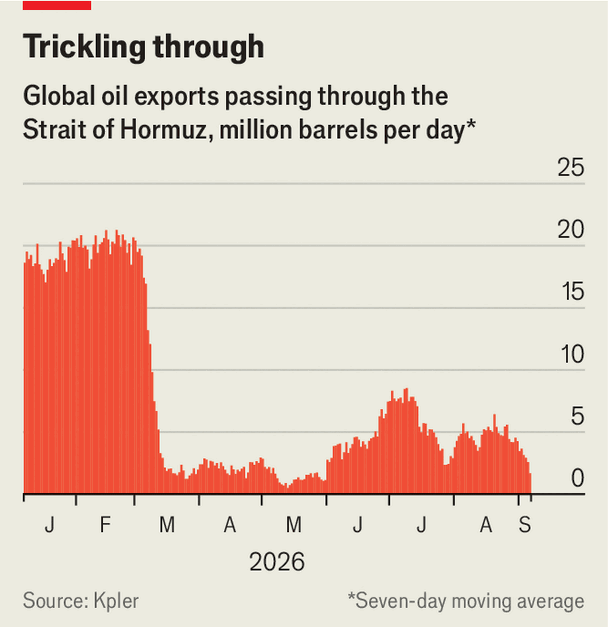
With Brent crude crossing $100 per barrel for the first time since July, Washington and Tehran are locked in an intense data war over shipping flows through the Strait of Hormuz. President Donald Trump claimed on September 3rd that oil volumes have rebounded to 18m barrels per day (b/d)—close to the pre-war 20m b/d benchmark—while Vice-President J.D. Vance asserted that Iran’s maritime control is broken. Conversely, top Iranian security officials dismissed these claims as fabrications, stating daily crossings have dropped to just seven or eight vessels. Independent commodity trackers concur; Kpler placed outflow below 5m b/d for the week ending August 30th.
This discrepancy stems from rampant maritime evasion and differing counting methodologies. To dodge Iranian strikes, tankers routinely switch off automatic transponders, navigate at night out of satellite range, manipulate radio signals, and transfer barrels clandestinely in the Gulf of Oman. Analysts must reconstruct passages retrospectively from loading manifests, meaning initial tallies serve as conservative floors (Kpler later revised early August estimates from 4.7m to 7.2m b/d). While official figures might conflate crude with refined products and count inland bypass pipelines—such as Saudi Arabia’s Petroline to the Red Sea (1m–3m b/d) and the UAE’s Habshan-Fujairah link (1m b/d)—Trump’s 18m b/d figure remains an implausible political embellishment.
Physical shipping realities firmly contradict the administration's claims of normalization. Retaliatory naval skirmishes caused daily transits to plunge from 23 to just eight on September 8th, while Houthi attacks continue to harass Red Sea alternatives. Marine hull insurance for Hormuz transits remains prohibitively elevated at 10% of vessel value, compared to 0.25% before the conflict, reflecting persistent threats from drifting naval mines and missile salvos. With North Sea Dated crude climbing past $113 and US diesel topping $200 a barrel, Trump’s suggestion that the war will drag beyond the midterms ensures sustained volatility for global energy markets.
Source: Is traffic through Hormuz really back to normal?
Subtitle: America would like the world to think so as oil prices top $100 again
Dateline: Sep 10th 2026