天文学家利用哈伯太空望远镜对 N44 展开详细的恒星普查,编目了近 50 万颗恒星,其中包括近 3 万颗尚未进入主序星阶段的前主序星。哈伯的高灵敏度与高解析度使科学家能够在明亮且拥挤的星云中辨识微弱的低质量恒星,并深入探讨新生恒星的质量如何决定其生命周期。
除了中央超级气泡,由单一高温恒星雕刻出的较小气泡(如 N44F)与气体柱,具体展现了新生大质量恒星如何重塑其诞生环境。此外,大麦哲伦星系的金属丰度较低,类似于宇宙早期的环境,这使得 N44 成为研究低金属条件下恒星形成历程的绝佳天然实验室。
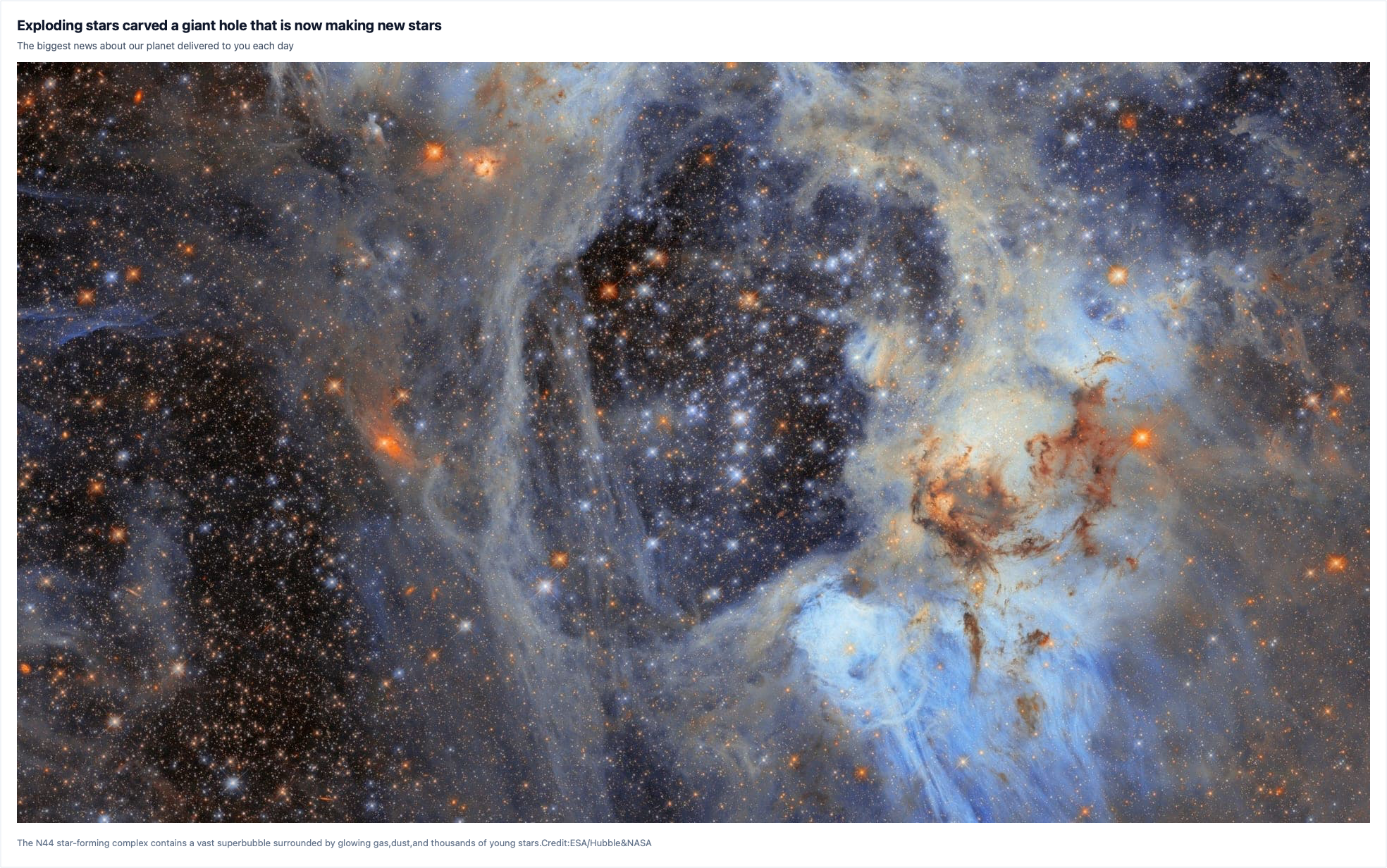
The N44 star-forming complex in the Large Magellanic Cloud hosts a massive superbubble cavity carved out by powerful stellar winds and supernova explosions from massive stars. The displaced gas accumulated into a dense outer shell that now acts as a stellar nursery, triggering the birth of new stars and allowing astronomers to study multiple stages of stellar formation in one location.
Using the Hubble Space Telescope, astronomers surveyed nearly half a million stars in N44, identifying roughly 30,000 pre-main-sequence stars that have not yet begun hydrogen core fusion. Hubble's exceptional resolution and sensitivity enable researchers to detect faint, low-mass stars in crowded regions, helping determine the initial stellar masses that dictate their subsequent lifespans and evolution.
Features like N44F, shaped by the fierce stellar winds of a single massive star alongside prominent gas pillars, illustrate how newborn stars actively reshape their natal environments. Because the Large Magellanic Cloud has a lower abundance of heavy elements, studying N44 provides astronomers with a vital laboratory to understand star formation under conditions reminiscent of the early universe.