英国工党立法者希望通过选择大曼彻斯特前市长安迪·伯纳姆(Andy Burnham)接替基尔·斯塔默爵士(Sir Keir Starmer),在经历了两年的执政困境后重新开局。根据Stack Data Strategy在7月7日至14日期间对5,070名英国人进行的民意调查分析,如果伯纳姆担任工党领袖兼首相,工党的选票份额将增加2.1个百分点。他的主要政治优势在于英格兰北部,在该地区工党的支持率上升了约6个百分点,而在曼彻斯特周边地区则激增了近10个百分点。尽管英格兰北部仅占议会席位的26%,但《经济学人》的选举模型指出,工党赢取议会多数席位所需的边缘选区中,约有45%分布在该北部地区。
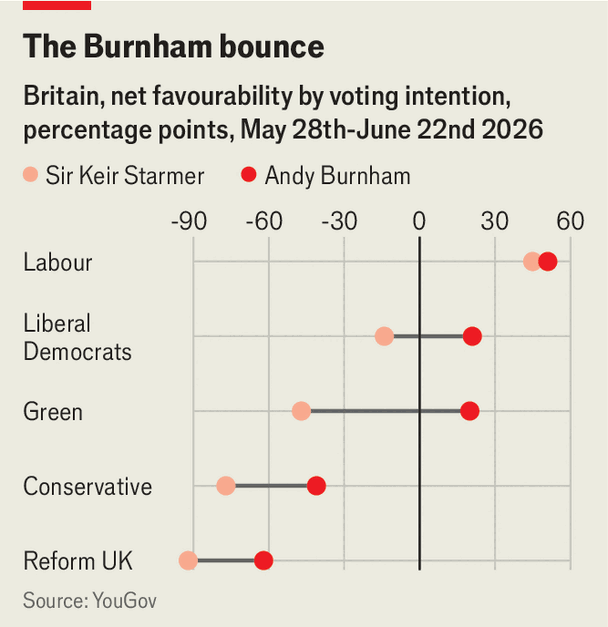
此外,伯纳姆的北部背景使其在社会阶级认知上具备显著优势。尽管他曾在剑桥大学受教育,仍有大约46%的英国人认为他是工人阶级,而斯塔默这一比例仅为14%,前卫生大臣韦斯·斯特里廷(Wes Streeting)仅为18%。民调数据表明,由伯纳姆接替斯塔默不会改变工党在中产阶级职业群体中的得票率,但在最底层的工人阶级职位群体中,工党得票率将提高3.6个百分点。虽然部分评论员认为他能吸引右翼民粹主义的改革党(Reform UK)支持者,但数据表明,在伯纳姆领导下仅有2%的改革党支持者转向工党,而自由民主党为4%,保守党为5%,绿党则高达6%。在净好感度方面,伯纳姆在绿党和自民党支持者中分别获得+20和+21分,但在改革党支持者中仅为-62分;相比之下,斯塔默在三者中的评分分别为-47分、-14分和-92分。
面对这些数据,伯纳姆面临着向左翼靠拢以团结中左翼阵营的诱惑与风险。一方面,左翼选民高度集中在少数选区,而在多数议员面临改革党挑战的选区中,从改革党争取选民的政治价值实质上是双倍的;另一方面,斯塔默过去的经验表明,推行左翼政策并未能赢得持久支持,其温和派定位与中左翼议程的脱节反而在左右两端均疏远了选民,导致截至2026年5月,近三季度的英国人认为他优柔寡断。伯纳姆即将于7月30日迎来自其大曼彻斯特市长继任者选举的首个选举考验。尽管改革党在5月的地方选举中曾以明显优势赢下该地区,但最新民调显示工党候选人已重占据优势并有望获胜。
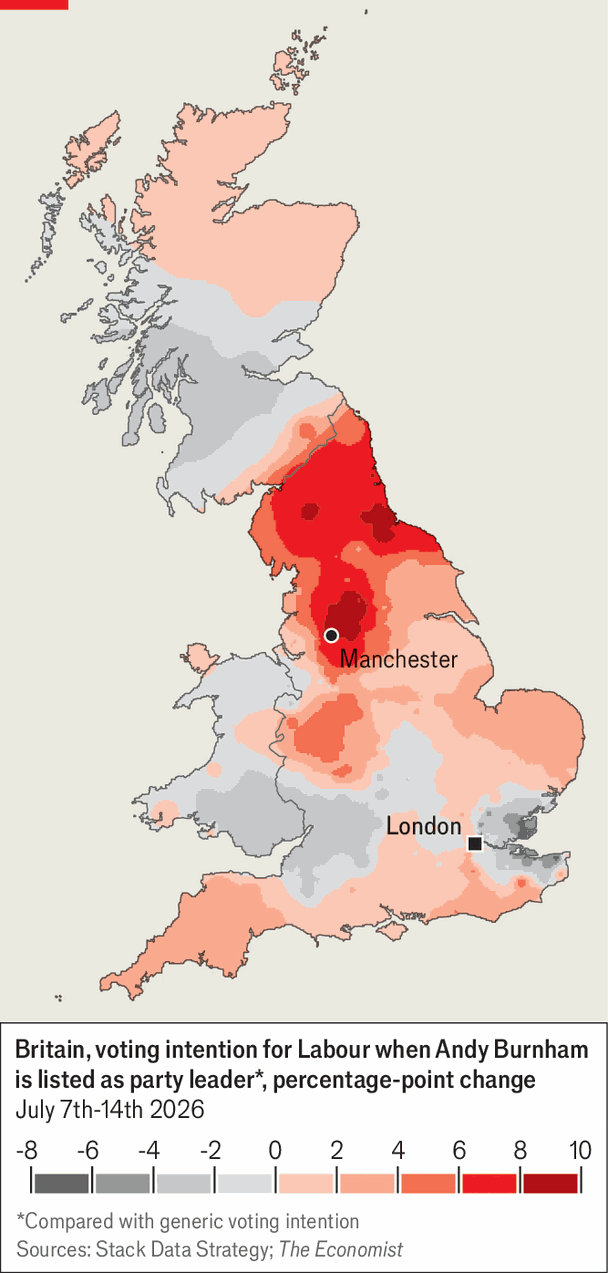
Labour MPs hope that choosing former Greater Manchester mayor Andy Burnham to replace Sir Keir Starmer will refresh the party's standard after two troubled years in power. According to an analysis of a survey of 5,070 Britons conducted by Stack Data Strategy between July 7th and 14th, having Mr Burnham as Labour leader and prime minister would boost the party's total vote share by 2.1 percentage points. His principal electoral asset lies in the north of England, where Labour's vote share under his leadership rises by around 6 percentage points overall, and by nearly 10 percentage points around his political home in Manchester. Although only 26% of parliamentary seats are located in the north, The Economist’s election model indicates that approximately 45% of the marginal constituencies Labour requires for a parliamentary majority are situated in this region.
In addition to regional appeal, Mr Burnham’s northern background provides a distinct advantage within Britain’s class dynamics. Despite holding a degree from Cambridge University, roughly 46% of Britons view Mr Burnham as working-class, compared with just 14% for Sir Keir and 18% for former health secretary Wes Streeting. Polling data show that replacing Sir Keir with Mr Burnham would leave Labour’s vote share unchanged among middle-class professionals, while increasing it by 3.6 percentage points among working-class workers. Although some commentators suggested he might attract right-wing Reform UK voters, only 2% of Reform supporters switch to Labour under Mr Burnham, whereas 4% of Liberal Democrats, 5% of Conservatives, and 6% of Green voters do so. Net favorability ratings reinforce this trend: Mr Burnham scores +20 points among Green supporters and +21 among Liberal Democrats, but a dismal -62 among Reform voters, outperforming Sir Keir’s respective ratings of -47, -14, and -92.
These figures present both opportunities and strategic risks should Mr Burnham attempt to unite the left-of-centre voting bloc to defeat Reform UK. Left-wing voters are heavily concentrated in specific constituencies, whereas direct switchers from Reform are effectively worth double in the majority of seats where Reform is the primary challenger. Furthermore, Sir Keir’s tenure showed that left-leaning policies failed to solidify support, creating political whiplash that led nearly three-quarters of Britons to view the prime minister as indecisive by May 2026. Mr Burnham’s immediate electoral test arrives on July 30th during the mayoral by-election for his former seat in Greater Manchester. Although Reform won the area by a clear margin in the May local elections, recent polling suggests the Labour candidate is currently on track for victory.
Source: His supporters are more northern and more Green than Sir Keir’s
Subtitle: [[IMAGE]]
Dateline: Jul 23rd 2026