今年5月柬埔寨一处湖泊浮起约两吨死鱼、上月印度尼西亚湖水水位下降露出长期淹没的索芒村(Somang)遗迹,以及菲律宾警告首都马尼拉即将削减供水,都预示着厄尔尼诺现象正在亚洲引发严重危机。本轮厄尔尼诺始于今年5月,预计下月达到峰值并持续至明年2月,太平洋海面温度异常的某项日度指标已突破有记录以来的所有历史峰值。这对数亿人依赖农业为生且正受伊朗战争能源冲击的亚洲造成了直接破坏:提供印度近70%年降水量的季风降雨量比正常水平低约13%,遭遇十年来最干旱的雨季;卫星数据显示印尼正经历11年来最严重的火灾季;菲律宾已有7个省份陷入干旱,预计明年初全国都可能面临旱情,而印尼10月至12月的主季水稻播种以及因水库干涸被政府要求停止种植第二季水稻的泰国中部灌溉农田均首当其冲。
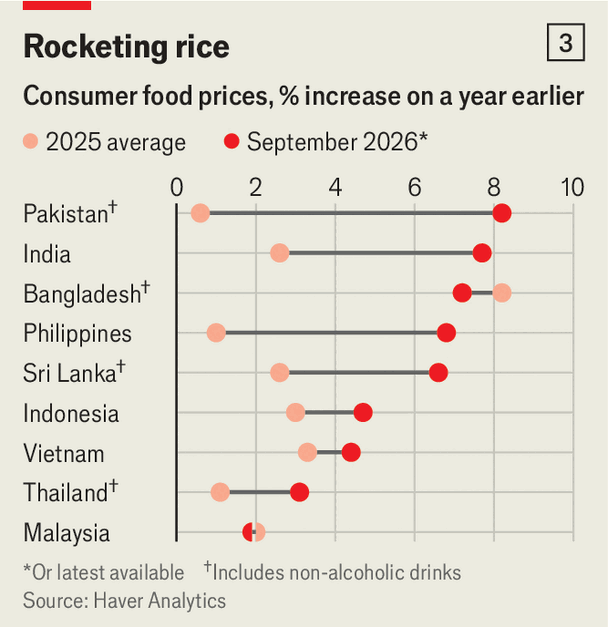
厄尔尼诺还与伊朗战争导致的燃料和化肥供应中断叠加:世界银行预计今年化肥平均价格将比去年上涨38%,推动印度年化食品通胀率从1月的2.1%升至8月的6%,斯里兰卡9月食品通胀率则达到7%。更令人担忧的是粮食供应,泰国泰京银行(Krungthai)估计从现在到明年年中泰国大米产量可能下降18%,而根据美国农业部的数据,孟加拉国的大米库存还不到其年消费量的4%。《经济学人》针对11个亚洲新兴经济体构建的“脆弱性指数”显示,斯里兰卡、孟加拉国和柬埔寨处境最差(若饱受战争蹂躏的缅甸数据完整,可能位居榜首),较富裕的泰国和马来西亚表现最好;此外,河流干涸削减水电出力与高温增加空调需求迫使各国燃烧更多煤炭,印尼山火烟雾更使新加坡空气质量在10月12日被评为全球最差(甚至超过德里)。
研究显示1997年的厄尔尼诺在随后五年内给全球经济造成了近6万亿美元损失,而联合国估计,若今年的食品和能源价格冲击完全转嫁给家庭,全球将有约1.32亿人陷入贫困,其中9100万在亚洲。幸运的是,更完善的预测使各国政府能够提前应对:印度正引导干旱地区农民改种豆类等作物,菲律宾发放抗旱种子,亚洲开发银行专家则建议各国在峰值到来前设立专项信贷额度和灾害保险。尤其有价值的是在预测突破水库水位等预设阈值时发放资金的“预期行动”,联合国认为在这方面每投入1美元可节省高达7美元的后续损失和援助;然而,由于富裕捐赠国收紧钱袋,联合国世界粮食计划署和粮农组织今年6月为保护阿富汗、巴基斯坦和菲律宾等22个国家的880万人而寻求的2.02亿美元资金,目前仅筹集到4000万美元。
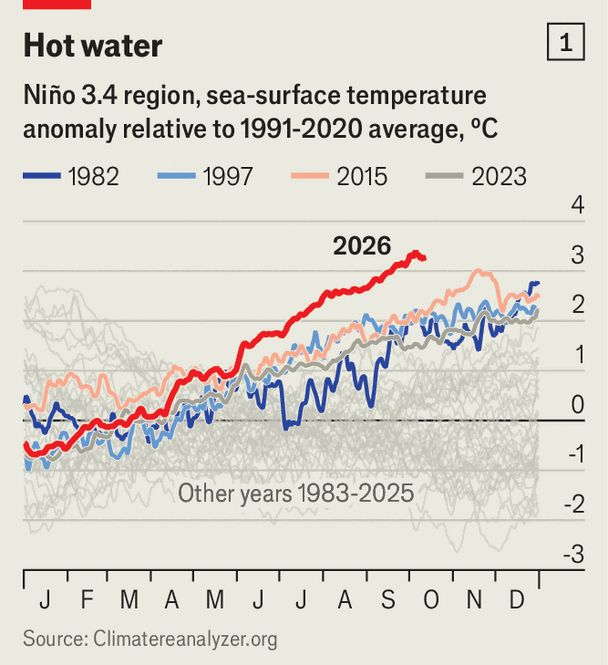
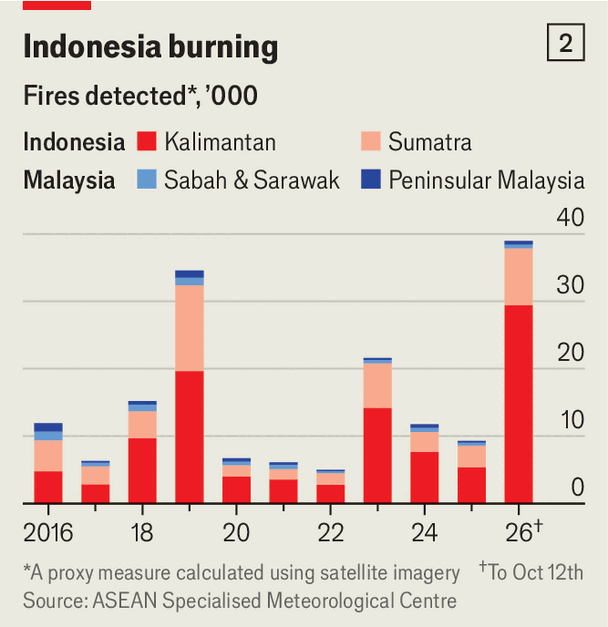
Isolated warning signs—from two tonnes of dead fish floating up in a Cambodian lake in May and receding Indonesian waters exposing the submerged village of Somang last month to water-supply warnings in Manila—herald a fierce El Niño across Asia. Having begun in May, this episode is set to peak next month and last into February, with daily Pacific sea-surface temperature anomalies already surpassing every recorded historical peak. Across a region where hundreds of millions rely on farming, damage is mounting: India’s monsoon, which provides nearly 70% of annual rainfall, ended about 13% below normal for its driest season in a decade; Indonesia faces its worst fire season in 11 years just as main rice planting runs from October to December; seven Philippine provinces are in drought with nationwide drought possible by early next year; and depleted reservoirs prompted Thailand’s government to ask central farmers to skip a second rice crop.
Compounding the weather shock, the Iran war has disrupted fuel and fertiliser supplies, with the World Bank projecting average fertiliser prices to jump 38% this year, driving annual food inflation from 2.1% in January to 6% in August in India and to 7% in September in Sri Lanka. Supply risks are even starker: Thai bank Krungthai estimates Thailand’s rice output could drop 18% by mid-2027, while US Agriculture Department data show Bangladesh’s rice stocks cover less than 4% of annual consumption. An Economist vulnerability index covering 11 emerging Asian economies ranks Sri Lanka, Bangladesh, and Cambodia as most exposed (excluding war-torn Myanmar due to patchy data) and richer Thailand and Malaysia as most resilient; meanwhile, falling hydropower and rising air-conditioning demand are increasing coal burn, and Indonesian fire smoke gave Singapore the world’s unhealthiest air on October 12th, worse even than Delhi’s.
Whereas the 1997 El Niño cost the global economy nearly $6trn over five years, the United Nations estimates that passing this year’s food-and-energy price shock fully onto households would push 132m more people into poverty worldwide, including 91m in Asia. Fortunately, improved forecasting allows governments to prepare: India is nudging parched districts toward pulses, the Philippines is distributing drought-resistant seeds, and Asian Development Bank experts urge pre-arranged emergency credit lines and disaster insurance. Although the UN calculates that every $1 spent on threshold-triggered “anticipatory action” saves up to $7 in losses and subsequent aid, financing remains scarce: of the $202m sought in June by the UN’s World Food Programme and Food and Agriculture Organisation to protect 8.8m people across 22 countries—including Afghanistan, Pakistan, and the Philippines—only $40m has been raised.
Source: Can Asian governments prevent a food shock?
Subtitle: El Niño is hitting countries that are already dealing with an energy shock
Dateline: Oct 15th 2026\n