长期以来,数学家们在证明该猜想上进展缓慢,过去的最佳上限值仍然会随著对象数量的增加而显著增长,距离常数目标相去甚远。然而在2025年秋天,理论计算机科学家尼基尔·班萨尔和蒋昊天宣布了近三十年来的首次重大突破。他们设计出了一种全新的算法,成功将差异上限降低至对象数量对数的四次方根,这个数值增长极其缓慢,在实际应用中已经无限接近于一个常数。
这项突破的关键在于他们的算法不仅能测量整体差异,还能巧妙地控制不同维度属性之间的依赖关系,从而在分组微调时减少相互干扰。虽然这个结果尚未完全证明科姆洛什猜想,但它极大地增强了学界对该猜想成立的信心。此外,这种高效的新算法不仅为彻底解决该问题带来了希望,未来还可能广泛应用于机器学习、物理学以及其他优化理论领域。
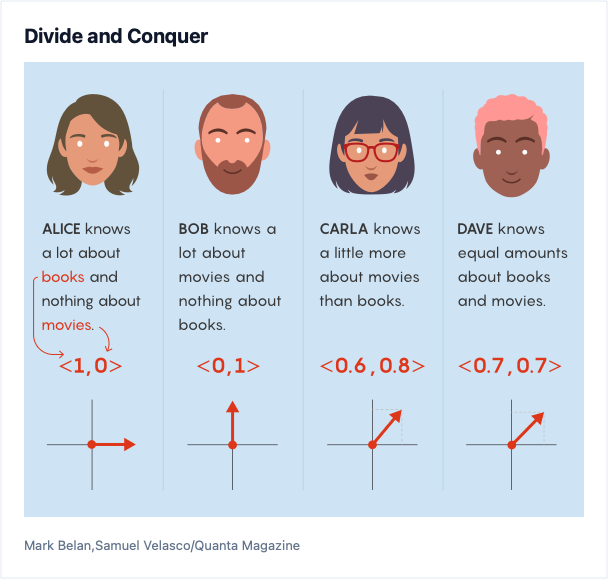
Combinatorial discrepancy theory is a branch of mathematics focused on allocating resources or objects as evenly as possible between two groups. In the 1980s, mathematician János Komlós proposed a counterintuitive conjecture stating that no matter how many objects or dimensions are considered, the discrepancy (or imbalance) when dividing them will never exceed a constant amount. This universal constant theory, known as the Komlós conjecture, seemed somewhat absurd even to its creator and has remained an unproven holy grail in the field for decades.
For a long time, mathematicians made slow progress in proving the conjecture, as the best previous upper limits still grew significantly with the number of objects, remaining far from a constant. However, in the fall of 2025, theoretical computer scientists Nikhil Bansal and Haotian Jiang announced the first major breakthrough in nearly thirty years. They designed a novel algorithm that successfully lowered the discrepancy bound to the fourth root of the logarithm of the number of objects, a value that grows so slowly it is practically close to a constant in real-world applications.
The key to this breakthrough lies in their algorithm's ability to measure not only the overall discrepancy but also cleverly control the dependencies between different dimensional attributes, thereby reducing mutual interference during subtle group adjustments. Although this result does not completely prove the Komlós conjecture, it has greatly boosted the academic community's confidence in its validity. Furthermore, this highly efficient new algorithm not only brings hope for fully resolving the problem but also holds potential for broad future applications in machine learning, physics, and other optimization theories.