全球极端高温引发的避暑需求,正将空调(AC)及电力获取问题转化为重大的政治与社会矛盾。据《柳叶刀》医学期刊模型估计,2000至2019年间全球每年约有48.9万人死于高温,而空调每年挽救了约19万名65岁及以上老人的生命。在美国,20世纪住宅空调的普及使极热天气的死亡风险降低了约75%。然而,在拥有近10%人口却占据全球36%高温死亡病例的欧洲,家庭空调普及率仅为23%,这促使极右翼与左翼政治势力就空调推广与气候影响展开激烈博弈。
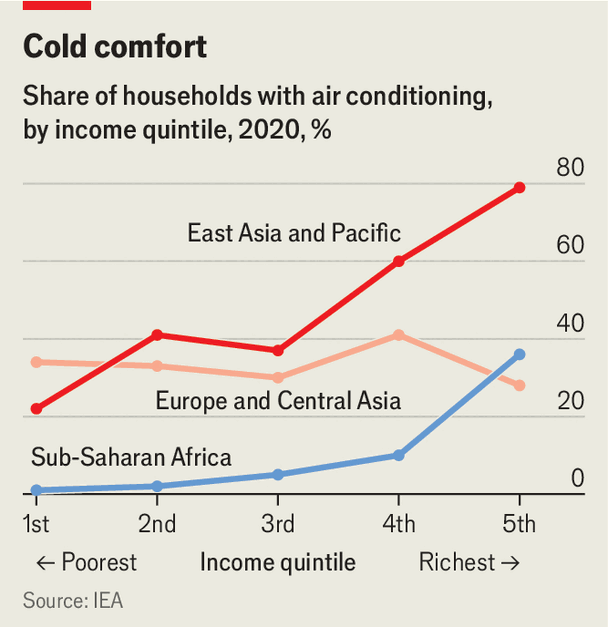
在广大发展中国家,空调获取的政治与经济壁垒更为显著。尽管全球超过80%的人口生活在需要降温的高温环境中,但目前仅有40%的人能够使用空调。以印度为例,其在2019至2024年间新增了约5,000万台空调,预计未来十年还将增加1.3亿至1.5亿台。然而,贫困家庭将高达8%的收入用于降温用电,而全球富裕家庭这一比例仅为0.2%至2.5%。此外,低效空调的使用极大地加剧了电网负担,印度仅降温用电需求就占到其高峰电力的四分之一,预计到2035年该峰值需求将翻三倍达到180吉瓦,引发频发的停电与社会抗议。
气候变化与降温设施匮乏对经济生产力与教育构成了长期威胁。国际劳工组织估计,到2030年高温压力将消除全球2.2%的工作时间,相当于损失8,000万个全职工作岗位,主要集中在南亚和西非的农业部门。虽然由70多个国家发起的“全球冷却誓言”及世界银行旗下国际金融公司(IFC)估计的4,000亿至8,000亿美元资金需求凸显了全球应对缺口,但目前国际援助仍偏重于被动降温手段。与此同时,市场需求持续爆发,本夏季中国向欧盟出口的空气调节设备增长了43%,达到38亿美元。
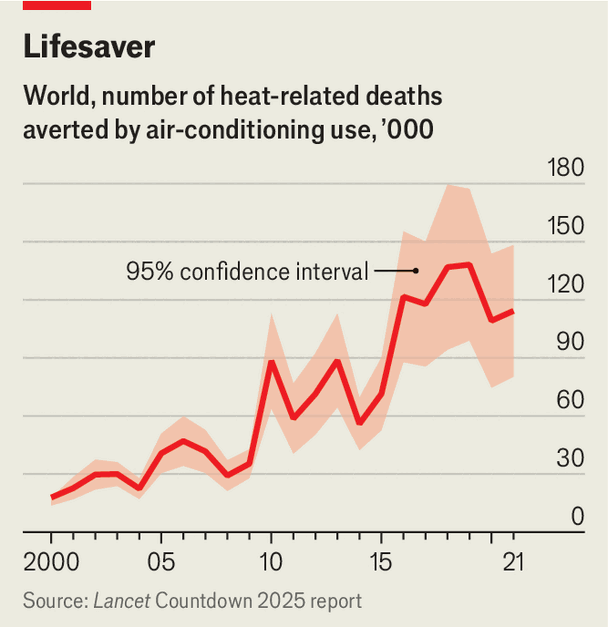
Surging extreme heat worldwide is elevating access to air-conditioning (AC) and reliable power grids into a critical political issue. Modeling published in the Lancet estimates that between 2000 and 2019, roughly 489,000 people died annually from heat-related causes, while AC usage by the early 2020s averted approximately 190,000 heat-related deaths per year among individuals aged 65 and older. In the United States, residential AC adoption accounted for a 75% reduction in mortality risk on extremely hot days over the 20th century. Conversely, Europe accounts for 36% of global heat deaths despite hosting less than 10% of the world's population, with only 23% of European households currently possessing AC units.
In developing nations, the political economy of cooling presents even sharper economic constraints. Although over 80% of the global population resides in regions requiring thermal cooling, only 40% currently have access to AC. India added approximately 50 million AC units between 2019 and 2024—equivalent to half of Europe's total—with forecasts predicting an additional 130 million to 150 million units over the coming decade. However, the poorest households in low-income nations spend up to 8% of their income on cooling electricity, compared to 0.2% to 2.5% for wealthy households globally. Inefficient cooling units severely strain grid infrastructure, with AC accounting for nearly a quarter of India’s peak electricity demand, which could triple to 180 gigawatts by 2035.
Unmitigated extreme heat paired with grid instability poses substantial risks to global economic productivity and human capital. The International Labour Organization projects that by 2030, heat stress will reduce total global working hours by 2.2%—equivalent to 80 million full-time jobs—disproportionately impacting agricultural sectors in South Asia and West Africa. Although the International Finance Corporation estimates that closing the cooling gap in emerging markets requires between $400bn and $800bn, international aid initiatives remain largely focused on passive cooling designs. Meanwhile, market adoption continues rapidly, with Chinese exports of AC units to the European Union jumping 43% year-on-year this summer to $3.8bn.
Source: Heatwaves are making access to AC a political problem around the world
Subtitle: [[IMAGE]]
Dateline: Jul 23rd 2026